Digital access is now part of the insurance service journey, but access alone does not prove that the experience is useful. The real question is whether policyholders can complete meaningful tasks with less confusion and fewer repeat contacts.
Why portal logins are not enough
Digital insurance programs often start with a simple question: are policyholders using the portal or mobile app? That is a useful adoption signal, but it is not a useful experience benchmark on its own. A login can mean a customer found the answer quickly. It can also mean the customer could not understand a claim email, could not find an ID card, had to check whether a payment posted, or was returning for the third time because the prior visit did not resolve the issue.
For insurers and MGAs, the more valuable question is not whether someone entered a digital channel. It is whether that digital channel helped them finish the task they came to complete. That difference matters because policyholder digital experience is not one journey. It includes policy service, claims, billing, documents, proof of insurance, alerts, identity verification, and escalation. Measuring only logins hides friction across all of those moments.
This is especially important as policyholders become more comfortable using insurer websites and apps for research, purchase, and service. Recent digital insurance research shows that web and app interactions now play a larger role in insurance shopping and servicing. That creates opportunity, but also raises the bar. A policyholder who starts digitally expects the next step to be clear, personalized, and connected to the action they need to take.
The benchmark insurers should start with: task completion
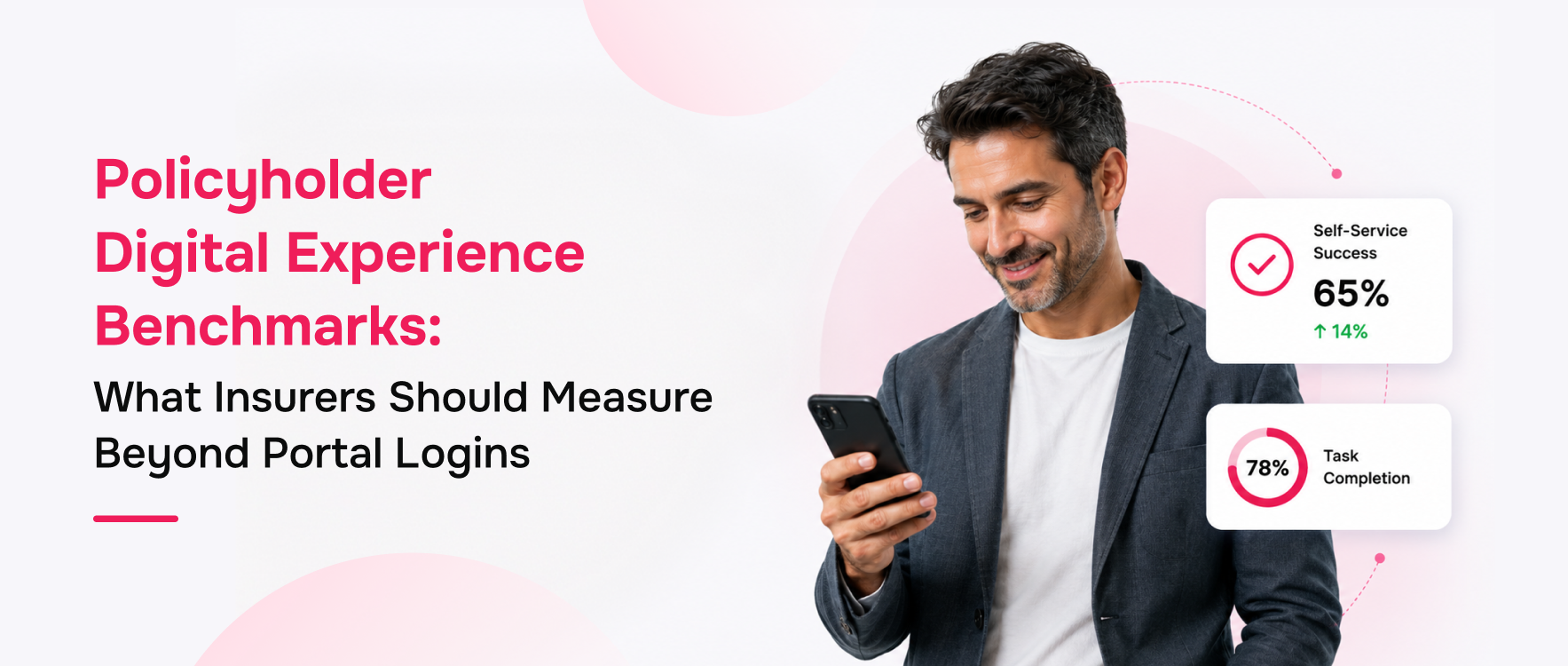
Task completion rate is the cleanest way to measure whether a digital experience is working. Instead of reporting that 40,000 policyholders logged in last month, insurers should know how many successfully completed common tasks such as downloading an ID card, uploading claim documents, viewing a payment confirmation, checking claim status, requesting policy changes, or locating policy documents.
This benchmark is useful because it connects digital engagement to operational outcomes. If many policyholders start a claim documentation workflow but abandon it before uploading required photos, the issue may be unclear instructions, file-size limits, missing mobile guidance, or uncertainty about what images are needed. If policyholders open billing pages repeatedly but still call the contact center, the experience may not answer the real question: did the payment post, what is due, and what happens next?
The goal is not to make every journey self-service only. The goal is to know which journeys can be completed digitally, which journeys need better guidance, and which should escalate quickly to an agent, adjuster, or service representative.
Repeat-contact reduction shows whether digital solved the issue
Repeat contact is one of the most practical experience benchmarks because it reveals whether digital journeys reduce uncertainty or simply move it around. If a policyholder checks claim status in an app and then calls 10 minutes later, the status page may technically exist, but it did not provide enough detail to prevent the call. If a customer downloads billing documents and then emails support, the document may be available, but the journey may not explain balances, due dates, fees, or payment posting clearly enough.
Insurers should compare digital activity against call, email, chat, and agent inquiry data. Useful questions include: which digital tasks are followed by calls most often, which pages have high repeat visits, which alerts drive policyholders back into a channel, and which journeys lead to a successful resolution without a second contact? This is where digital experience measurement becomes more than marketing analytics. It becomes a service operations tool.
Self-service containment should be measured carefully
Self-service containment can be helpful, but only when it is defined responsibly. A contained interaction should mean the policyholder completed the intended task or received a clear next step. It should not mean the customer gave up, failed to escalate, or was forced through a dead-end chatbot path.
For insurance, containment should be segmented by journey type. Downloading an ID card, updating basic contact information, paying a premium, uploading photos, or viewing documents may be good candidates for high self-service completion. A disputed claim decision, severe loss, suspected fraud issue, complex coverage question, or emotionally sensitive complaint should have a lower threshold for human handoff. Benchmarking should reflect that difference.
Measure escalation quality, more than escalation volume
Escalation is not a failure when it happens at the right time. In fact, a strong digital experience often makes escalation better because the policyholder has already authenticated, selected the reason for contact, uploaded documents, or shared context before reaching a human. The right benchmark is not simply how many customers escalated. It is whether the escalation preserved context and reduced rework.
Important escalation metrics include time to handoff, reason for escalation, documents collected before escalation, whether the representative received journey context, and whether the issue was resolved after the handoff. This helps insurers avoid one of the most frustrating customer experiences: repeating the same story across mobile, chatbot, portal, email, and phone.
Where Xemplar Engage comes into play
Xemplar Engage fits this measurement-led approach because it is built around connected policyholder engagement, not a single static login page. Its branded insurance mobile app, insured portal, PolicyBuddy chatbot, push notifications, and admin visibility can help insurers and MGAs bring common policyholder actions into one engagement layer. That matters when the measurement goal is not channel usage alone, but journey performance across service moments.
For example, an insurer can look beyond app downloads and track which journeys policyholders use most, where they need reminders, which workflows create follow-up calls, and where digital self-service should connect to human support. This positions digital experience as an operating model, not a cosmetic portal update.
A practical benchmark scorecard for insurers
A useful scorecard should combine adoption, completion, quality, and operational impact. Start with digital adoption by journey instead of total logins alone. Then measure task completion, abandonment points, repeat-contact rate, escalation rate, average time to completion, document completion quality, notification engagement, and customer satisfaction after key workflows. Add operational indicators such as call deflection, service backlog reduction, adjuster follow-up reduction, and billing inquiry reduction.
The most important rule is to connect each benchmark to a business question. Are policyholders finding answers faster? Are service teams receiving fewer avoidable calls? Are claims teams getting better documentation earlier? Are billing and document requests moving out of the contact center? Are MGAs able to offer carrier-grade service without adding manual work? These questions make measurement practical and make the digital program easier to defend internally. A useful scorecard should combine adoption, completion, quality, and operational impact. Start with digital adoption by journey instead of total logins alone. Then measure task completion, abandonment points, repeat-contact rate, escalation rate, average time to completion, document completion quality, notification engagement, and customer satisfaction after key workflows. Add operational indicators such as call deflection, service backlog reduction, adjuster follow-up reduction, and billing inquiry reduction.
The most important rule is to connect each benchmark to a business question. Are policyholders finding answers faster? Are service teams receiving fewer avoidable calls? Are claims teams getting better documentation earlier? Are billing and document requests moving out of the contact center? Are MGAs able to offer carrier-grade service without adding manual work? These questions make measurement practical and make the digital program easier to defend internally.
FAQ’s
- What is policyholder digital experience?
Policyholder digital experience is the quality of the mobile, web, portal, chatbot, notification, and self-service journeys that help insurance customers manage policies, claims, documents, billing, and support. - What metrics should insurers use beyond portal logins?
Insurers should measure task completion, repeat-contact reduction, self-service containment, escalation quality, abandonment points, document completion, notification engagement, and operational impact. - Why are portal logins a weak benchmark?
A login only shows that a customer entered a channel. It does not prove the customer completed the task, understood the next step, or avoided a service call. - How can Xemplar Engage support better measurement?
Xemplar Engage supports connected mobile, portal, chatbot, notification, and admin experiences, helping insurers see digital engagement across practical policyholder service workflows.