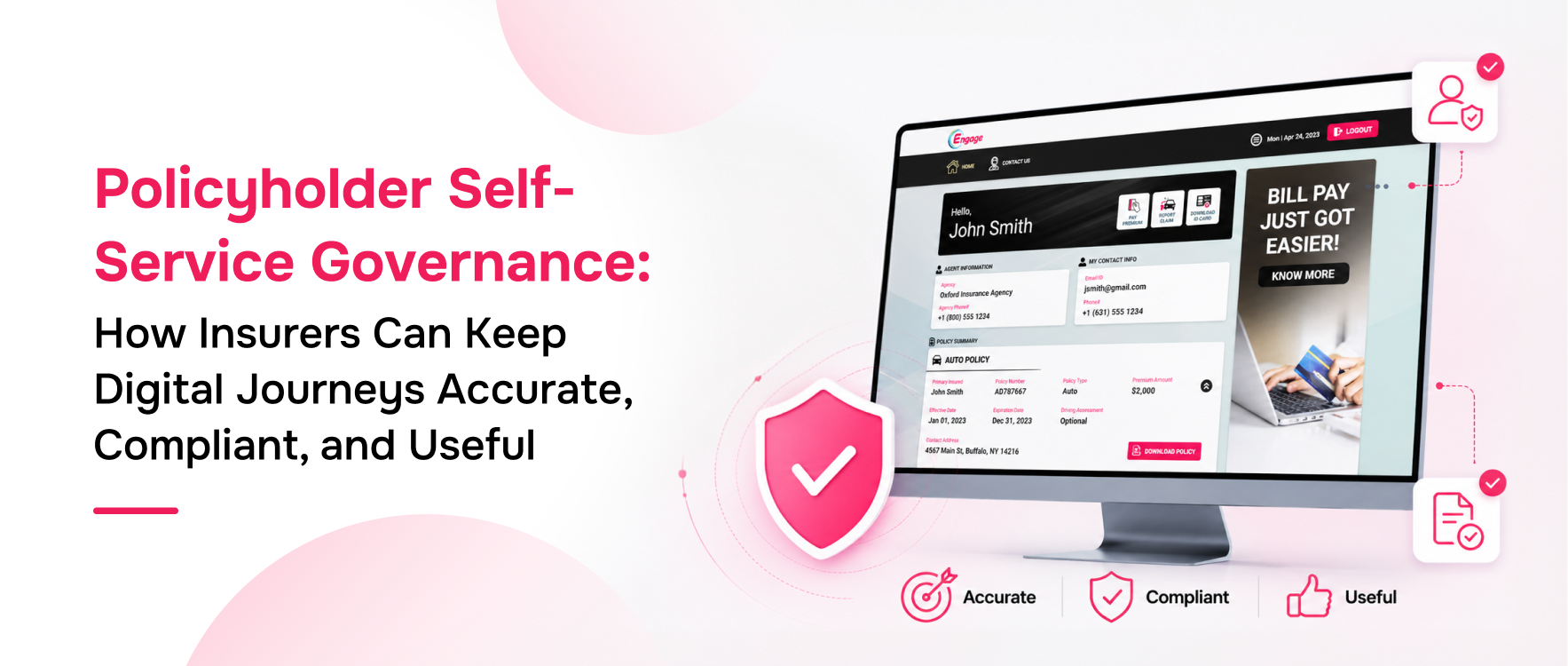
Self-service only works when the information, workflow, and escalation path stay accurate after launch. That is why governance is a core digital experience issue for insurers.
Launching self-service is not the finish line
Many insurers treat a portal, mobile app, or chatbot launch as the end of a digital project. In practice, launch is the beginning of the governance challenge. Policy language changes, billing rules change, claim workflows change, compliance requirements evolve, documents are updated, and customer questions shift. If no one owns those changes inside the digital experience, self-service becomes stale.
Policyholder self-service governance is the discipline that keeps digital journeys accurate, compliant, and useful over time. It defines who owns content, who approves workflow changes, how updates are prioritized, how exceptions escalate, how compliance reviews happen, and how performance is monitored. Without governance, even a well-designed portal can become a source of misinformation or frustration.
Why governance matters in insurance more than in many industries
Insurance service journeys involve regulated information, coverage-sensitive language, billing rules, claims documentation, customer identity, and sometimes emotionally difficult situations. A wrong answer is more than inconvenient. It may create compliance risk, service complaints, customer confusion, or downstream operational work.
This is why self-service content cannot be managed like a generic FAQ library. Answers about claims, billing, cancellation, documents, coverage, and policy changes need ownership and review. Digital workflows also need controls. A broken escalation path or outdated document request can create problems that a simple content refresh will not solve.
What a self-service governance model should include
A strong governance model should include journey ownership, content ownership, approval workflows, update cadence, compliance review, escalation rules, performance monitoring, and change management. It should also define how customer feedback and service data are used to improve digital journeys.
For example, claims may own claim documentation language, billing may own payment-related content, compliance may review regulated disclosures, customer experience may monitor task completion, and operations may track call drivers. Governance brings these teams together so the policyholder experience remains coherent.
The biggest risks of unmanaged self-service
Unmanaged self-service often fails quietly. Policyholders may stop using the portal, repeat the same calls, abandon digital forms, ignore chatbot answers, or complain to agents. Internally, teams may assume digital is working because the tool is live. The real issue is that the content or workflow no longer matches customer needs or operational reality.
Common risks include outdated claim instructions, incorrect billing explanations, broken document links, unclear status messages, missing escalation paths, duplicated answers across channels, inconsistent terminology, and no clear owner for fixes. These problems reduce trust and make digital service less effective.
Where Xemplar Engage comes into play
Xemplar Engage can be positioned as a digital engagement layer that supports governed self-service across mobile, portal, chatbot, notifications, and admin-facing visibility. The article should emphasize operational control: insurers need a way to manage and monitor digital service journeys, beyond publish a portal and hope customers use it.
This is especially relevant for insurers and MGAs that operate across multiple systems and teams. Xemplar Engage can help create a more organized policyholder-facing experience while giving internal teams better visibility into engagement, content, and workflow performance.
How insurers can start governing self-service
The practical starting point is a journey inventory. List the top policyholder tasks across claims, billing, documents, policy service, account access, notifications, and support. For each journey, identify the business owner, content owner, compliance reviewer, system dependency, escalation path, update frequency, and success metric.
Next, connect governance to performance. If a page has high repeat visits followed by calls, review the content. If a chatbot topic escalates frequently, review the answer and workflow. If document upload abandonment rises, review the instructions and mobile usability. Governance should not be a static committee. It should be a feedback loop between customer behavior and operational improvement.
Governance makes AI-search content stronger too
Governed self-service also supports AI-search visibility. Search engines and AI answer systems are more likely to surface content that is clear, structured, accurate, and regularly maintained. Insurance content that explains definitions, workflows, limitations, and next steps in plain language is easier for both customers and answer engines to understand.
This does not mean stuffing pages with keywords. It means making each journey clear enough to answer real questions: what can the customer do digitally, what information is needed, what happens next, when should they contact support, and how does the insurer keep information current?
A governance checklist for policyholder self-service
A practical governance checklist should answer the following questions for every self-service journey: Who owns the content? Who owns the workflow? Which compliance review is required? Which system feeds the information? How often should the journey be reviewed? What happens when information is missing? What is the escalation path? Which metric shows whether the journey is working?
The checklist should also include channel consistency. If claim documentation instructions appear in a portal, chatbot, email, and mobile app, all versions should match. If billing language changes, it should be updated across digital channels. If a regulatory disclosure is revised, teams should know where that disclosure appears and who approves the update.
This level of governance may sound operational, but it directly affects customer experience. Policyholders do not care which department owns an answer. They care whether the answer is accurate and whether the next step works.
How governance supports continuous improvement
Governance should create a rhythm for improvement. Monthly or quarterly reviews can examine top digital tasks, failed searches, abandoned forms, repeat-contact drivers, chatbot escalations, document access issues, and notification performance. Each signal should lead to an owner and a fix, not simply another report.
This is where insurers often gain the most value from self-service analytics. The data shows where policyholders are trying to help themselves and where the experience is breaking down. Governance turns that data into action by assigning responsibility and tracking improvement over time.
Implementation checklist for self-service governance
Insurers can start with a governance map that assigns one owner to every major digital journey. Claims should own claim instructions. Billing should own payment and invoice language. Compliance should review regulated content. Digital or customer experience teams should monitor usability and performance. Operations should connect digital trends to service volume.
The governance map should also include a change process. When a form, rule, notice, workflow, or disclosure changes, the team should know which portal pages, chatbot answers, notifications, FAQs, and documents must be updated.
This prevents the common problem of digital channels drifting apart over time. Customers experience one insurer, even when internal teams manage different parts of the journey. Governance keeps that experience consistent.
FAQs
- What is insurance self-service governance?
Insurance self-service governance is the operating model for maintaining accurate content, workflows, approvals, compliance controls, escalation paths, and performance reviews across digital service journeys. - Why does self-service governance matter for policyholders?
It helps help make sure that policyholders receive accurate information, clear next steps, current documents, and appropriate support when digital service is not enough. - Who should own insurance self-service governance?
Digital, operations, claims, billing, compliance, customer experience, and product teams should share governance responsibilities with clearly assigned journey owners. - How does Xemplar Engage support governed self-service?
Xemplar Engage supports connected mobile, portal, chatbot, notification, and admin experiences that can help insurers manage policyholder engagement more consistently.