Insurers often focus on claims cost, indemnity, leakage, litigation, and reserves. However, the first notice of loss, a critical stage in the claims process, frequently receives insufficient attention.
FNOL is where cost, customer perception, and operational efficiency intersect. It is also where many insurers still rely heavily on phone-based intake, manual data capture, and follow-up calls that slow everything down before a claim even truly begins.
At a time when social inflation continues to push settlements higher, litigation is increasing, and claim severity is rising across lines; inefficiency at intake is no longer tolerable. The earlier friction enters the process, the more expensive the claim becomes.
Fortunately, FNOL remains an area where insurers can achieve meaningful improvements quickly, without disrupting core claims handling or adjuster workflows.
Why FNOL Still Creates So Much Friction
Most claim leaders are familiar with these challenges.
Call queues increase after event loss. Intake teams struggle to collect complete information, and adjusters often receive claims that require clarification before investigation can begin. Customers, already stressed, must repeat details, wait on hold, or navigate rigid IVR trees. Each additional touchpoint adds time. Each delay adds cost.
What is often overlooked is how early friction compounds downstream.
Incomplete FNOL data increases cycle time. Longer cycle time increases expense. Delays raise the likelihood of attorney involvement. The result is a claim that costs more than it should, long before indemnity decisions are made.
This issue stems from intake, not claims handling.
The Cost of Phone-First Claims Intake
Phone-based FNOL is expensive by default. It requires trained staff, consistent availability, and rework when information is missed or misunderstood.
More importantly, it does not scale gracefully.
After weather events or regional losses, call volumes surge. Wait times increase. Data quality drops. Customers grow frustrated at the worst moment. Reducing intake calls is not about pushing people away from human support. It is about reserving human involvement for cases that need it.
Routine FNOL submissions should not require a phone call.
What a 10-Minute FNOL Experience Really Means
A well-designed digital FNOL experience does not feel rushed. It feels focused.
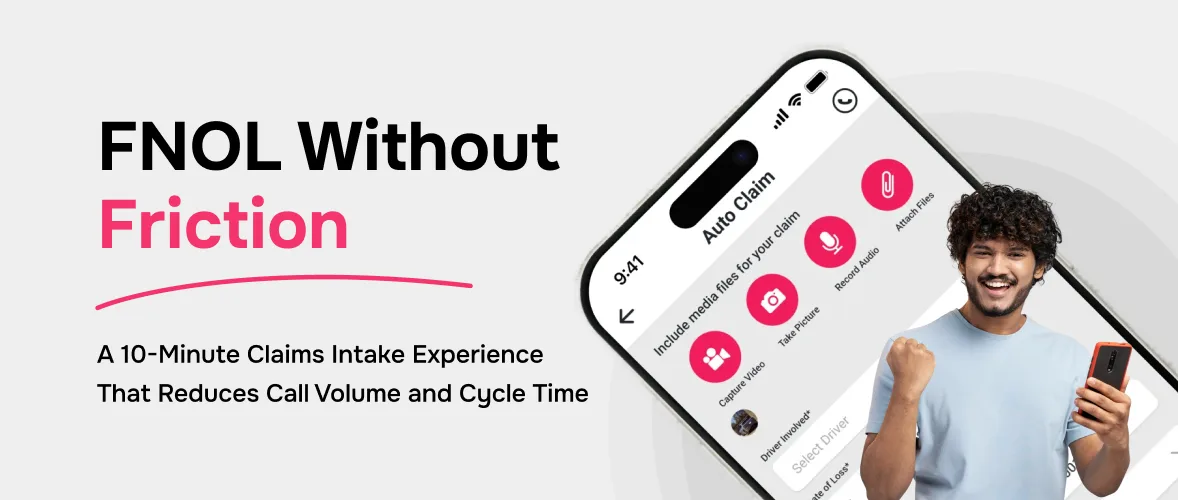
In ten minutes or less, a claimant should be able to submit a claim, upload supporting details, and receive clear confirmation of next steps. No guessing. No backtracking. No follow-up calls to fill gaps.
This works because digital workflows ask better questions, in the right order, based on context.
They validate inputs in real time. They guide the claimant instead of interrogating them. With conversational interfaces, such as chat-based intake, insurers can meet customers where they are, without forcing app downloads or lengthy forms.
The result is not just faster intake. It is cleaner data from the start.
Reducing Call Volume Without Hurting Experience
One of the biggest concerns claim leaders raise is whether self-service intake will frustrate customers. In practice, the opposite is often true.
Customers want clarity, speed, and reassurance. They want to know their claim has been recorded correctly and what happens next.
When digital FNOL workflows are complete and intuitive, customers choose them willingly. Call volume drops not because access is restricted, but because calls are not necessary.
This is where chatbot-driven workflows add value. They handle guided conversations, answer common questions, and collect structured information without sounding scripted or impersonal.
These workflows do not stop at FNOL. They can also support related actions, such as collecting premiums, sharing claim updates, or handling follow-up requests, further reducing inbound calls over the life of the claim.
Why This Matters Now More Than Ever
The claims environment is not getting easier.
Social inflation continues to drive higher settlements. Litigation is increasing in both frequency and cost. Every extra day a claim remains open adds pressure to loss ratios and expense lines.
Improving FNOL efficiency does not solve all of this, but it removes unnecessary friction at the beginning of the process.
Cleaner intake data reduces rework. Faster initiation shortens cycle time. Better early communication lowers claimant anxiety, which can reduce escalation later. In a high-cost claims environment, small improvements at intake can have a significant financial impact.
FNOL as an Operational Strategy, Not a Channel Decision
Digital FNOL should not be viewed as a channel shift. It is an operational strategy.
Self-service workflows and conversational intake allow insurers to standardize how claims enter the system, regardless of volume fluctuations. They improve consistency without adding headcounts. They protect adjuster time for investigation and resolution, not data collection.
This is the approach we see working across carriers who invest in end-to-end intake design rather than isolated tools. Platforms like those from Xemplar Insights focus on connecting self-service and chatbot workflows directly into claims operations, ensuring intake data is usable, timely, and complete from the start.
Wrapping up – The Quiet Impact of Better FNOL
FNOL is not where the claims strategy ends. It is where it begins.
A ten-minute, friction-free intake experience does more than reduce calls. It shortens cycle time, improves data quality, and removes costs before it can grow.
In an environment defined by rising claim severity and external pressures, insurers cannot control. Fixing what happens in the first ten minutes is one of the most practical steps leaders can take.
Reduce intake calls Improve data quality Faster claims
Book a 30-minute FNOL workflow demo
Frequently Asked Questions
- Can digital FNOL really reduce intake calls?
Yes. When workflows are complete and intuitive, customers choose them over calling. The reduction is driven by preference, not restriction. - Does this work for complex claims?
Digital intake is especially effective for routine and moderate claims. Complex cases still benefit from cleaner initial data and faster escalation. - How quickly can insurers see the impact?
Many see reductions in call volume and intake of rework within the first few months of rollout. - Is chatbot-based FNOL secure and compliant?
When properly designed and integrated, conversational workflows meet security and compliance requirements while improving accessibility.